Revolutionizing TaaS at Infor
From UX Engineering → Product Experience → Adoption Strategy → Growth Thinking
At Infor, I worked as a UX Software Engineer contributing to a Testing-as-a-Service (TaaS) platform across enterprise environments.
While the role focused on:
- UI/UX
- Frontend engineering
- Learning experience design
The real challenge extended far beyond building features.
It required:
→ Making a complex enterprise product usable, adoptable, and scalable
This naturally evolved into responsibilities aligned with a
Product Experience & Adoption Strategist
The Problem
Enterprise platforms often fail not due to a lack of features, but due to low adoption and usability friction.
Key challenges in the TaaS product:
- Complex workflows → High cognitive load
- Fragmented user journeys across tools
- Limited onboarding → users struggled to get started
- Underutilized features despite high capability
- Low engagement in a B2B SaaS environment
This reflects a broader enterprise challenge where systems must become more intuitive, efficient, and integrated to truly deliver value.
The Opportunity
Transform TaaS from a feature-heavy tool
into a guided, adoptable product experience
Shift from:
- Interfaces → Workflows
- Features → User outcomes
- Access → Adoption
- Usage → Value realization
The Solution
Designed and contributed to a holistic product experience system combining:
- UX (User Experience) → Simplified, structured flows
- LXD (Learning Experience Design) → In-product learning & onboarding
- Design Systems (SOHO) → Consistency & scalability
- Front End Development → Responsive, accessible & functional interfaces
- Adoption Thinking (Emerging) → Activation, usability, engagement
The Process
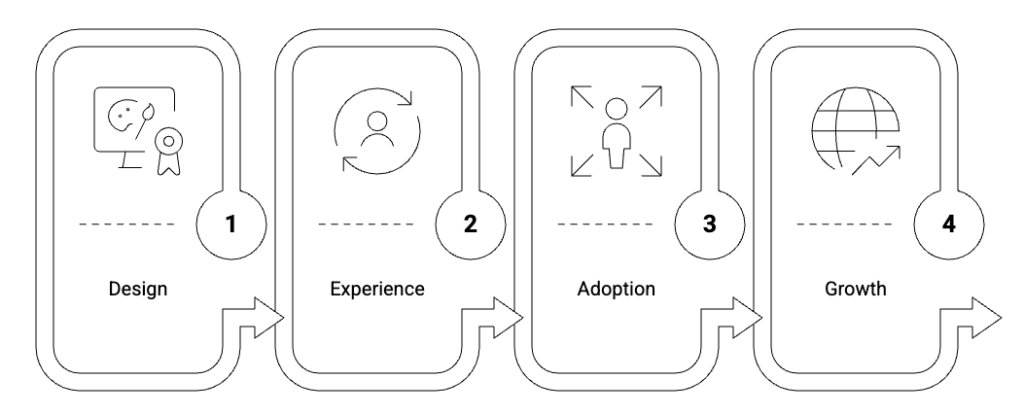
1. Design (UX Engineering + Product Foundation)
Goal: Reduce complexity and improve usability at scale
Key Tasks
- Redesigned complex enterprise workflows into simplified, modular flows
- Applied design system (SOHO) for consistency across products
- Developed responsive, scalable UI across desktop, mobile, and cloud
- Collaborated with product + engineering teams for feasibility
Strategic Evidence
Shifted focus from “UI screens” → end-to-end product usability
2. Experience (UX + LXD Integration)
Goal: Help users not just use, but understand and succeed
Key Tasks
- Designed in-product learning experiences (LXD)
- Created onboarding-like guidance within workflows
- Reduced friction through clear states, feedback, and actions
- Improved task clarity across testing flows
Impact
- Increased user confidence in performing tasks
- Reduced dependency on external documentation
Strategic Evidence
Introduced learning inside the product—a key driver of adoption
3. Adoption (What I Contributed + What Was Emerging)
Goal: Improve activation, usability, and continued usage
What Was Done
- Reduced friction in first-time usage flows
- Improved clarity of actions and next steps
- Embedded guidance within the interface
Adoption Thinking Applied
- Activation → Faster task completion
- Engagement → Reduced confusion loops
- Retention → Better usability = repeat usage
What I Identified (Strategist Thinking)
- Need for structured onboarding journeys
- Need for feature discoverability systems
- Need for usage analytics to track adoption
Strategist Evidence
Began bridging UX with product adoption thinking
4. Growth
Goal: Enable long-term product success and scale
User Growth
- Improve onboarding → faster time-to-value
- Align product flows with real enterprise tasks
Product Growth
- Feature prioritization based on usage data
- Expand in-product guidance & automation
Retention
- Continuous learning within the product
- Progressive workflows based on user maturity
Business Impact
Enterprise platforms like those from Infor aim to help organizations operate more efficiently and dynamically through better systems and workflows
Impact & Evidence of Success
Product Experience
- Improved usability across complex enterprise workflows
- Reduced friction in key testing processes
User Experience
- Increased clarity → better task completion
- Reduced reliance on external support
Adoption Indicators (Indirect but Strong)
- Higher usability → improved repeat usage
- Better onboarding-like flows → faster activation
Strategic Impact
- Shifted product thinking from:
- ❌ Feature delivery
- ✅ User experience + usability-driven adoption
My Role Evolution (Proof of Strategist Level)
Role Title
UX Software Engineer
What I Actually Did
- Designed end-to-end product experiences
- Built scalable UI systems
- Integrated learning into product workflows
What I Demonstrated
- Product thinking beyond UI
- Understanding of user behavior & adoption gaps
- Ability to connect Experience → Adoption → Growth
Key Takeaway
Enterprise UX is about clear workflows—not screens—where reducing complexity, embedding in-product learning, and leveraging design systems enable scalable adoption and strategic impact.
Please note: Due to company confidentiality and copyright restrictions, I am unable to include any direct screenshots or visual assets from the TaaS project. Full Design Case Study is here